
Form a unified business with the Adaptive Arts product suite
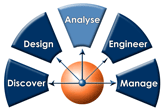
One of the considerations when merging organisations is determining how the various business processes, people and organisation roles can be brought together to form a unified business. Much effort is made to bring the information systems into a common infrastructure. Yet, the success of the merger depends to a much greater degree on the ability to identify and rationalise the business processes which are utilised within the individual organisations. Further benefit can be attained by taking the opportunity to improve the processes within the various departments of each of the organisations.
When mergers are considered, is it because benefit can be gained through the opportunity to cross-sell products to an expanded customer base? Possibly it is the ability to combine products in a synergistic manner to create products with expanded capability and much greater value to the customer. Or perhaps it is just an opportunity to reduce the costs through greater scale?
Whatever the motivation, there needs to be consideration given to the manner in which the combined business will operate. This requires much more than a simple combination of the organisation structures and a rationalisation of the roles. Most importantly, there is a need to bring the business processes together so that the combined organisation can benefit from best practices. This may require modification to the processes within each organisation. This can only be determined by reviewing, documenting and mapping the detailed processes. This can be performed by taking a one-dimensional view of the processes and have these processes compared manually. However, this does not take account of the people who are involved in the processes, the roles they perform elsewhere in the organisation and the impact on their other activities.
Adaptive Arts assist organisations to build multi-dimensional models which include the business processes as well as the roles, people, information usage and supporting IT systems. The business processes are still mapped in the manner described above. The difference is that information is also captured regarding the people, roles and information which interacts with the business processes. As detail regarding each of the business processes is captured, a richer model of the organisation is being built. A by-product of this exercise is that definition of roles is being clarified. This is achieved with the Adaptive Arts Modeler.
When the enterprise models are merged, the result can be viewed as the integration of business processes as well as the combination of the roles. Given the new requirements for the organisation, it is now much more apparent how the business processes and roles can be optimised. This can include performance information as metrics are maintained against the processes and the roles. By combining all the information throughout the new organisation model, executive management can view the overall impact on the business.